Overview
FlexiChains.jl provides a rich data structure for storing and analysing Markov chain Monte Carlo (MCMC) output.
using Turing, FlexiChains
@model function f()
    x ~ Normal()
    y ~ Poisson(3.0)
    z ~ MvNormal([x + y, x - y], I)
end
chain = sample(f(), Prior(), MCMCSerial(), 1000, 4)╭─FlexiChain (1000 iterations, 4 chains) ──────────────────────────────────────╮
│ ↓ iter = 1:1000 │
│ → chain = 1:4 │
│ │
│ Parameters (3) ── VarName │
│ Float64 x │
│ Int64 y │
│ Vector{Float64} z (2,) │
│ │
│ Extras (3) │
│ Float64 logprior, loglikelihood, logjoint │
╰──────────────────────────────────────────────────────────────────────────────╯Primary features
Type and structure fidelity
FlexiChains preserves the original shapes of your samples: all Julia types are faithfully stored without modification. The example Turing.jl model above yields a FlexiChain where each x is a Float64, each y is an Int, and each z is a Vector{Float64}.
This is in contrast to many other representations which flatten all samples into a single Array{Float64}.
Diverse input sources
FlexiChains is the default chain type for Turing.jl since v0.45 of Turing.
You can also construct a FlexiChain from a variety of other sources, including ParallelMCMC.jl, Pigeons.jl, Stan CSV files, MCMCChains.jl, or PosteriorDB.jl.
Expressive indexing
You can access data stored in chains in a variety of ways, using the full power of DimensionalData.jl selectors.
chain[@varname(x), iter=101:End, chain=2]┌ 900-element DimArray{Float64, 1} Parameter(x) ┐
├───────────────────────────────────────────────┴────────── dims ┐
↓ iter Sampled{Int64} 101:1000 ForwardOrdered Regular Points
└────────────────────────────────────────────────────────────────┘
101 0.944378
102 0.393447
103 0.831016
104 1.46884
105 -1.74298
⋮
996 0.660304
997 -1.65671
998 0.354678
999 -0.398476
1000 2.12553Downstream analysis
FlexiChains provides a number of tools for statistical analysis, including:
simple statistics (mean, variance, quantiles, etc.)
MCMC diagnostics and statistics via MCMCDiagnosticTools.jl and PosteriorStats.jl
LOO-CV via PosteriorStats.jl and PSIS.jl
ss = summarystats(chain)╭─FlexiSummary (9 statistics) ─────────────────────────────────────────────────╮
│ iter collapsed │
│ chain collapsed │
│ ↓ stat = [mean, std, mcse, ess_bulk, ess_tail, rhat, q5, q50, q95] │
│ │
│ Parameters (4) ── VarName │
│ Float64 x, y, z[1], z[2] │
│ │
│ Extras (3) │
│ Float64 logprior, loglikelihood, logjoint │
│ │
│ Summary │
│ param mean std mcse … rhat q5 q50 q95 │
│ x -0.0049 0.9974 0.0166 1.0001 -1.6702 0.0073 1.6345 │
│ y 2.9943 1.7499 0.0277 1.0002 1.0000 3.0000 6.0000 │
│ z[1] 2.9578 2.2236 0.0358 0.9995 -0.4979 2.8081 6.8878 │
│ z[2] -3.0118 2.2761 0.0351 1.0004 -6.8883 -2.8896 0.4969 │
╰──────────────────────────────────────────────────────────────────────────────╯ss[@varname(x), stat=:mean]-0.004868790074474263For added versatility you can also convert a FlexiChain into a DimArray or a DataFrame.
Plotting
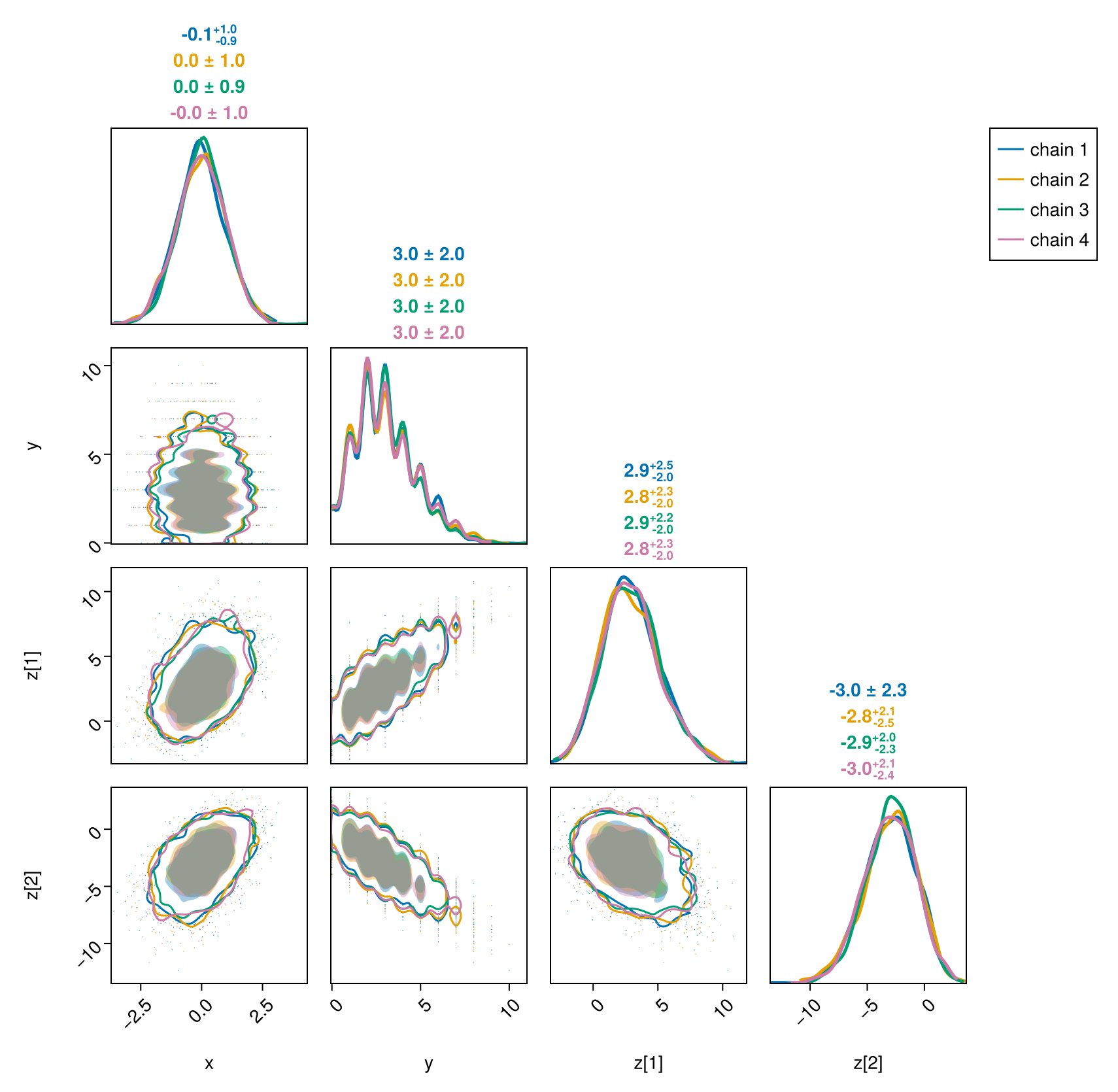
Many visualisation functions with both Makie.jl and Plots.jl backends are provided, along with a PairPlots.jl extension.
using PairPlots, CairoMakie
pairplot(chain)